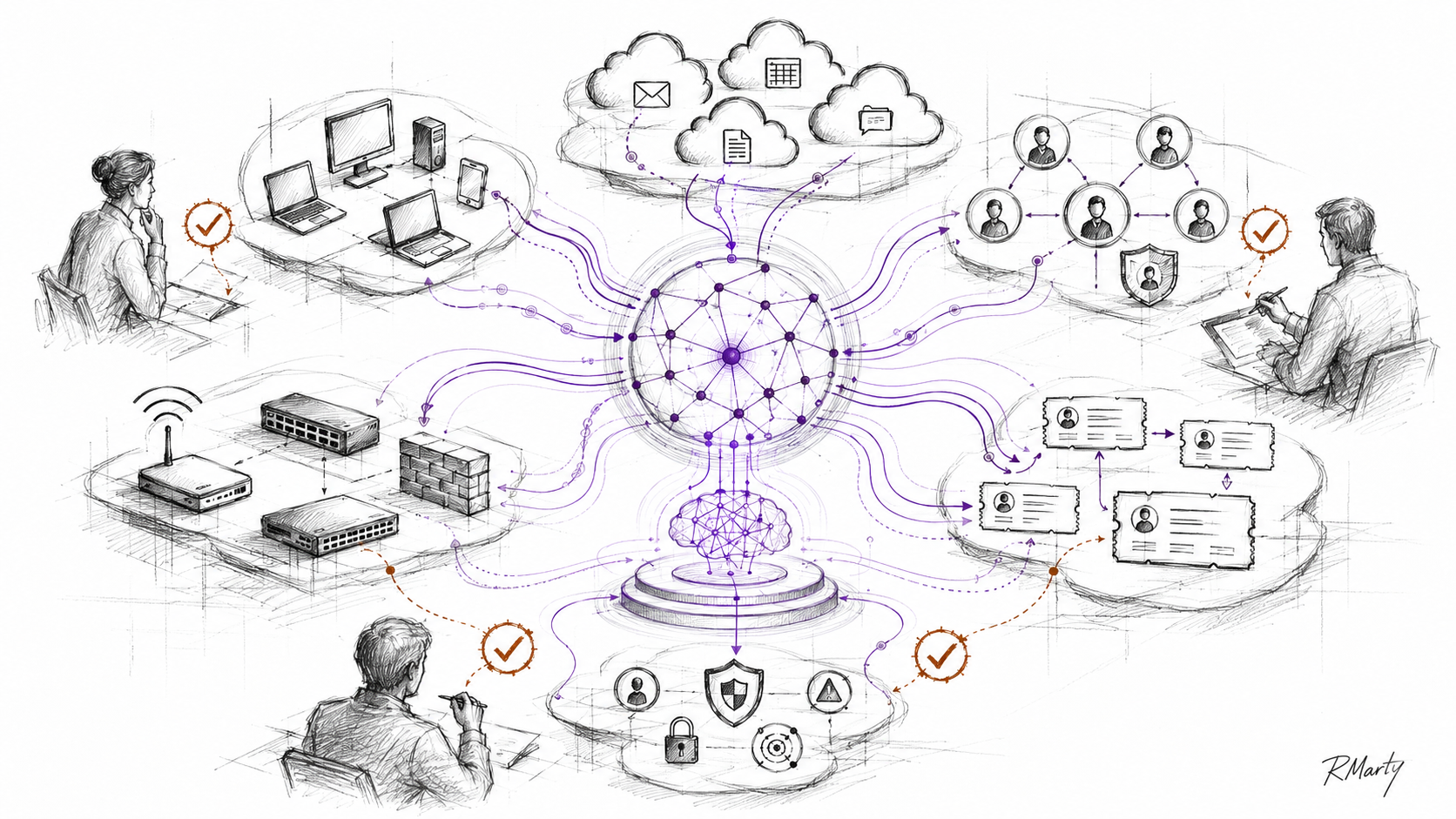
In the last two MDR posts, I looked at how MDR has to move beyond alert triage. First, the natural MDR extensions: asset and control coverage, exposure management, SIEM and data quality, cloud and identity posture, response orchestration, and proof that risk actually went down. Then, the deeper architecture: next-gen MDR as an AI-native SecOps control plane, where services become more productized, SIEM becomes symbiotic, and detection has to move into governed response.
This post is the next layer out.
Most conversations around AI in the MSP ecosystem still focus on copilots, workflow automation, and operational efficiency. Those are important, but they miss the larger transition underway. AI is forcing a redesign of the operational infrastructure underneath managed services itself, creating new platform dynamics and potentially large capital market opportunities across the SMB technology stack.
If MDR is becoming an AI-native SecOps control plane, what happens to the broader MSP market? My view is that the same operating shift is coming there too, but with a wider scope. The best MSPs will not just add AI to tickets, service desks, and support workflows. They may become the AI operations layer for SMB and mid-market infrastructure. That is a much bigger idea than “AI for MSPs.”
Services Are Becoming Software-Defined
Historically, software scaled and services did not. Services were people-heavy, exception-heavy, and hard to standardize. Good MSPs could improve process, stack discipline, and technician leverage, but the model still depended heavily on human execution.
AI changes part of that equation.
Support, remediation, governance, workflow routing, escalation, documentation, compliance evidence, and customer reporting can all become more software-defined. That does not eliminate the human operator. It changes the operator’s job from doing every step manually to designing, supervising, validating, and improving the operating loop.
This is why the boundaries between MSP, MDR, SaaS, outsourcing, and consulting start to blur. A managed service that is telemetry-driven, API-connected, AI-assisted, and outcome-accountable begins to look less like a traditional services business and more like an operating platform with humans in the loop.
MDR is one version of this. MSP is the broader version.
Copilot Is Not The End State
A lot of current AI messaging still sounds like copilot: summarize a ticket, draft a response, help an analyst investigate faster, recommend the next step, generate a report. That is useful, but it is not the final state. The customer is not really buying a better chat interface. They are trying to buy operational confidence.
For MSPs and MDR providers, the value stack is moving in this direction:
Old Value
Transitional Value
Future Value
Tools
Workflows
Outcomes
Tickets
Orchestration
Operational continuity
Alerts
Investigations
Risk reduction
Dashboards
Recommendations
Governed action
Labor
Automation
Confidence with accountability
This is where MSP and MDR converge. The customer does not want a PSA queue, RMM console, SIEM, EDR tool, dashboard, or pile of alerts. They want uptime, resilience, recoverability, compliance, secure productivity, fewer surprises, and someone accountable when the system does not behave the way it should. The product becomes operational confidence.
The Hard Part Is Operational State
This is also where a lot of “AI-first MSP” thinking is still too shallow. The hard part is not putting an LLM on top of a ticket queue. The hard part is knowing enough about the operating environment to take action safely. To automate IT and security operations, the system needs to know what exists, who owns it, what it connects to, what is business-critical, what policy applies, what telemetry is missing, what action is allowed, what could break, who can approve, how to roll back, and whether the action worked.
That requires an operational middleware layer:
Layer
Why It Matters
Asset and identity context
The system needs to know who, what, privilege, ownership, and business impact.
Telemetry quality
AI cannot reason well over missing, stale, or badly shaped data.
Workflow routing
The platform has to know when to automate, escalate, notify, or wait.
Policy and authority boundaries
Automation needs clear limits on what it is allowed to do.
Action and rollback controls
Remediation has to be safe enough for production environments.
Evidence and reporting
The provider must prove what changed, not just that work was performed.
This should sound familiar from the MDR discussion. The same architecture problems show up again: context, telemetry, workflow, policy, action, proof. The difference is that MSPs operate across a wider surface area. They touch endpoint management, identity, SaaS administration, backup, patching, compliance workflows, help desk, procurement, user onboarding, security tooling, and business continuity. That makes the AI opportunity larger, but it also makes the operating problem harder.
This is also why I am a proud advisor to FlowMind. They are tackling this problem from exactly the right angle: building a context graph across IT, network, cloud, and security knowledge, then using that context to automate ticket triage, investigation, and response. The important part is not just classifying the ticket faster. It is understanding the live customer environment well enough to recommend or execute the right fix.
AI-First MSP Is A Refounding, Not A Feature Upgrade
The phrase “AI-first MSP” can make the transition sound easier than it is. A true AI-native provider probably needs a different labor model, pricing model, knowledge system, telemetry stack, escalation chain, customer contract, operating metric set, and governance architecture. That is closer to a refounding than a modernization project.
The old MSP model optimized for human leverage: more endpoints per technician, better ticket workflows, tighter vendor standardization, and stronger recurring revenue. The next model has to optimize for governed automation: more safe actions per operator, better telemetry coverage, faster remediation loops, clearer authority boundaries, and stronger proof of outcome.
That also changes what investors and strategic acquirers should underwrite. Scale alone is not enough. Recurring revenue alone is not enough. A large MSP platform with fragmented tools, weak data architecture, inconsistent telemetry, and human-heavy workflows may not be an AI-native operating platform. It may just be a large labor organization with good retention.
The quality question becomes more operational: can this provider turn distribution, trust, and access into a compounding operating system?
The Practical Test
The test is not “does this MSP have AI?” That question is already too shallow. The better test is whether the provider can answer a few operating questions consistently:
Question
Why It Matters
What does the provider actually know about the customer environment?
AI leverage depends on accurate asset, identity, telemetry, and business context.
Which actions can be automated safely?
The value is not automation volume. It is governed action without breaking the customer.
Where does human approval still matter?
Autopilot still needs escalation, exception handling, and accountability.
Can the provider prove risk or operational burden went down?
Activity reporting is not enough if the outcome is confidence.
Does the operating model improve with scale?
The best platforms should compound knowledge and workflow quality across customers.
This is where diligence should move. Not just gross retention, endpoint count, technician utilization, or EBITDA margin, but whether the operating architecture is actually becoming more software-defined over time.
Distribution Is The Hidden Asset
The strongest strategic asset in the MSP market may not be the software stack. It may be the distribution layer.
MSPs already have something most AI vendors want and cannot easily build: trusted access into the SMB technology environment. They often have admin rights, endpoint access, SaaS integrations, procurement influence, business continuity responsibility, and a working relationship with the customer. That matters because SMBs generally do not have the internal capacity to manage AI transformation, AI governance, security operations, identity, SaaS posture, and workflow automation on their own. If AI agents become part of the workforce, somebody has to manage the operating environment around them. Identity, permissions, logging, workflow access, data boundaries, compliance, security, and incident response all have to extend from human employees to semi-autonomous systems.
That creates a larger role for the best MSPs and MDR providers. They can become SMB operational governance providers, not just outsourced IT or security teams.
The Market Will Not Reward Everyone
The dangerous assumption is that AI automatically increases the value of MSPs. It might. But it could also compress margins, reduce switching costs, commoditize service delivery, centralize operational intelligence in large platforms, and move value toward Microsoft, hyperscalers, or AI-native software vendors. The providers that benefit most will be the ones that turn service delivery into a software-defined operating model. The providers that only add AI features to the old model may see the opposite effect: more pricing pressure, less differentiation, and less tolerance for messy delivery. This is the broader implication of the AI-native MDR thesis. MDR may become the SecOps control plane. MSPs may become the operations and governance layer for the rest of the SMB technology stack.
The categories may keep their old names for a while: MSP, MDR, MSSP, SaaS, GSI, AI SOC. But the operating model underneath them is changing. The strategic question is no longer just who manages the tools. It is who becomes trusted to operate the customer environment as AI becomes part of the workforce.
MDR is not going away, but the old model is. The old model was service-first: collect alerts, have analysts investigate them, escalate what matters, and report what happened. That still solves a real problem, but it is not where the market is going.
The future MDR has to become product-first, AI-native, and action-oriented. It cannot just sit on top of EDR alerts and add analyst labor. It has to become the SecOps control plane that connects detection, investigation, response, exposure reduction, and proof of outcome.
This is not just an “AI layer” on top of alerts. It requires a different architecture, a different relationship with the SIEM, and a different operating model for response.
The Service Business Has To Become A Product Company
Traditional MDR was built as a service business. The product was often the people: analysts, playbooks, escalations, customer calls, and reporting. That model can scale to a point, but it starts to break when the market expects software-speed investigation and response.
Next-gen MDR has to invert the model. The platform becomes the core product, and services become the trust, expertise, and exception-handling layer around it. The test is margin and labor leverage. If more customers create more exceptions, more tuning, and more analyst burden, the company is still a service business. If more customers create more reusable detections, known-good patterns, automation recipes, and response policies, the service is becoming a product. Analysts still matter, but they should supervise, improve, validate, and handle edge cases. They should not be the primary execution engine for every repetitive investigation.
That is a hard transition because many MDR providers are not software companies. They can script, tune, and operationalize, but building a real SecOps platform is a different muscle.
The Moat Is Not AI. It Is Encoded Operational Judgment.
The defensible part of next-gen MDR is not that it uses AI. Everyone will use AI. The defensible part is whether the provider has converted years of SOC judgment into productized decision systems: known-good behavior, investigation procedures, response playbooks, customer-specific rules of engagement, approval policies, and feedback loops that improve the platform over time.
The best MDR providers will not simply have analysts assisted by AI. They will have a compounding operating system where every resolved case can improve future triage, investigation, automation, and response across customers. The weak version is service history trapped in analyst memory and exception lists. The strong version is structured, versioned, measurable operational knowledge embedded into the platform.
And let’s not forget the context graph. The data structure that learns the customer environments. The intelligence layer that fuses together individual data points to deliver a high signal, low friction security outcome.
MDR And SIEM Become Symbiotic
It’s a mistake think (or build a company around) next-gen MDR replaces the SIEM.
The SIEM is there for a reason. It stores logs, supports compliance retention, enables historical search, runs detections, and gives the customer a system of record for security data. Many customers already have years of detection logic, parsers, dashboards, and workflows inside it.
But the SIEM should not be the only operating layer for MDR. If MDR depends entirely on the (customer’s) SIEM, it inherits the SIEM’s latency, schema problems, data opacity, cost model, and workflow limitations.
The future relationship is symbiotic. MDR should use the SIEM’s detection layer where it works, but also audit it, monitor it, and improve it. Are the right logs arriving? Are detections still firing correctly? Are parsers broken? Are detections duplicated, stale, or missing context? Which investigation outcomes should feed back into detection logic?
In that model, the SIEM becomes less of the SOC’s user interface and more of a data and detection layer inside a broader SecOps operating system. It’s also feasible to have the SIEM be the data backend for the AI SOC, but only if it’s under the uninhibited control of the MDR.
AI Changes The Architecture, Not Just The Interface
The visible change in the near future is that analysts and customers will interact with the system(s) through AI. They will ask questions, start investigations, summarize cases, generate response plans, even design their own dashboards, and check what changed.
But the harder shift is underneath. The backend has to be built so AI can interact with it safely and efficiently. That means the platform needs clean APIs, stable entity models, permission-aware access, auditable actions, reusable investigation workflows, and compact context that does not require dumping endless raw logs into a model. And last but not least, the backend has to be designed for AI workloads and in turn, for token efficiency and for the types of (probably very suboptimal) queries that the AIs will send down.
This is why an AI-native SecOps platform is not the same as a chatbot on top of a SIEM. The architecture has to support the way AI investigates, acts, remembers, and learns.
Detection Has To Move Into Automated Response
The current MDR model still assumes a human-centered response loop: a detection fires, an analyst investigates, and someone decides whether to isolate, disable, block, remove, patch, ticket, or escalate. That loop is too slow for many modern attacks.
The future MDR platform has to move toward detection-to-response automation, but not reckless automation. Customers will push back, and rightly so. They do not want an opaque AI system taking production-impacting actions on its own. The answer is to be precise about what “AI” means.
Not every workflow needs an LLM. Much of response should become deterministic rules, policy engines, and pre-approved playbooks. GenAI should be reserved for the places where it helps: summarization, investigation planning, evidence interpretation, query generation, and edge-case reasoning. For most alerts, the system should be predictable, auditable, and constrained.
The second answer is supervision. Some actions can be fully automated. Some should require analyst approval. Some should require customer approval. The platform has to know the difference between removing a malicious email, disabling a privileged identity, isolating a production server, and changing access policy for a sensitive application.
The third answer is guardrails. We are entering the era of validation loops for AI: agents and control layers that check what the system proposes, understand disruption risk, enforce policy boundaries, and monitor whether the action worked. Formal guardrail frameworks, policy-as-code, approval gates, rollback paths, evals, and audit trails become part of the SecOps architecture.
This is where risk becomes the control signal. A suspicious event on a low-value test asset should not trigger the same response as the same event on a privileged identity accessing sensitive data. Risk should influence not only the analyst queue, but also resource access flows: step-up authentication, zero trust enforcement, restricted data access, endpoint isolation, email removal, identity reset, or escalation to a human.
That is the important shift. Detection should not only create an investigation. It should drive protection and exposure reduction.
The Market Implication
Next-gen MDR, AI SOC, and the MSP/MSSP security platform may look like separate markets today. Architecturally, they are converging. The packaging changes by segment, but the platform direction is increasingly the same.
Segment
What they have
What they actually need
Winning operating model
Failure mode
Enterprise
Internal SOC, SIEM, EDR/NDR, cloud, identity, often MDR already
Offload repetitive investigation, compress L1/L2 work, accelerate response, preserve control of L3 and security ownership
AI-native SecOps platform with optional managed expertise
Becomes another SOAR/chatbot layer that still requires too much engineering
Upper mid-market
Some SOC capacity, fragmented tools, inconsistent operations
Co-managed investigation and response, direct integrations, automation with customer control, risk/context model
Productized MDR / managed SecOps control plane
Gets squeezed by enterprise AI SOC platforms above and classic MDR below
Core mid-market
Limited security staff, enough maturity to respond, uneven tooling
Hybrid AI plus expert MDR, guided response, exposure visibility, outcome reporting
Next-gen MDR with embedded automation and human supervision
Stays stuck in analyst-assisted alert triage
SMB
Little or no security staff, MSP-led IT, low tolerance for complexity
MSP/MSSP-delivered security bundle with embedded MDR automation
Too many separate tools, too many escalations, no customer-side owner
Enterprise buyers will usually want to retain ownership of security operations. They may use managed expertise, but they are more likely to buy an AI-native SecOps platform that compresses L1/L2 investigation, improves consistency, and accelerates response while their internal team keeps control of higher-risk decisions. There is an opportunity for AI SOC players to provide the new sec ops platform for these enterprises as the central command – AI first, SIEM symbiotic.
Mid-market buyers are the most interesting and the most difficult. They often have enough security maturity to know they need help, but not enough staff or process maturity to run a pure platform themselves. This is where productized MDR can become the managed SecOps control plane: part platform, part expert service, part automation layer. The provider has to help operate the loop, not just forward alerts. The lesson is not to bolt on every adjacent service. Exposure management, asset visibility, identity posture, vulnerability prioritization, and response orchestration all matter, but they have to reinforce the MDR operating loop. If the provider adds too much service scope without product leverage, it becomes broad, expensive, and hard to deliver. This is also where we need the vendors to educate the market. Mid-market companies need these capabilities whether they ask for them or not. If they are buying separate tools for exposure management, asset inventory, vulnerability management, identity posture, and reporting, it is reasonable to ask why the MDR provider should not help operate those workflows. The customer can still supervise decisions, set policy, and approve sensitive actions. But the MDR should increasingly coordinate the operating loop. Ideally MDR players will open up their platforms for end customers to co-deliver security results.
SMB buyers may never experience this as an AI SOC platform. They may experience it through an MSP or MSSP security platform that bundles endpoint, email, identity, compliance, patching, response, and reporting all within one simple, per user license. But underneath, the same direction applies: more product, more automation, more risk context, more proof.
The future MDR is not an AI layer on top of alerts. It is not a cheaper SOC. It is not a duplicate SIEM. And it is not a service desk with better automation. The future MDR is a productized SecOps control plane: symbiotic with the SIEM, directly integrated with the customer’s enforcement tools, risk-aware in how it prioritizes and responds, deterministic where safety matters, AI-native where reasoning helps, and measured by proof of risk reduction. The companies that win will be the ones that turn service experience into compounding product advantage. The companies that lose will still have analysts, alerts, dashboards, and AI summaries, but no real moat.
In a previous post about the adjacencies to the MDR market, I laid out a framework for how MDR needs to evolve beyond alert triage. The basic idea was that future MDR should not just be “EDR alerts plus analysts.” It should become the control plane for cybersecurity operations and cyber risk reduction.
This post goes one level deeper. If MDR is going to become that control plane, what capabilities actually need to sit closest to the operating loop? The strongest extensions are the ones that help MDR understand what exists, what is exposed, what telemetry is missing, what response should happen, and whether risk actually went down.
Asset And Control Coverage
This is the starting point. MDR cannot protect an environment it does not understand, so the provider needs to know:
What exists?
What is unmanaged?
What lacks EDR coverage?
What lacks vulnerability scanning?
What logs are missing?
Which assets are business-critical?
Which controls are present, absent, or failing?
Asset context turns MDR from generic alert review into prioritized operations. An alert on a test machine is not the same as an alert on a domain controller, cloud control-plane asset, payment system, build server, or executive endpoint. An exposed vulnerability on an internet-facing revenue system is not the same as the same CVE on a low-value internal host.
The future MDR has to understand this context automatically in a dynamic envirionment.
Exposure And CTEM
This is probably the most important adjacency. Classic MDR waits for something to fire. Exposure management asks what can be attacked before the alert exists.
The future MDR should know:
What is exploitable?
What is internet-facing?
What is business-critical?
What is currently being targeted?
What attack paths exist?
What should be fixed first?
Which exposures actually got closed?
This is what moves MDR from reactive monitoring to proactive risk reduction. The important distinction is that this cannot just be scanner reporting. Vulnerability management becomes an MDR extension only when it is tied to exploitability, asset criticality, identity paths, observed threat activity, and actual remediation workflow.
SIEM And Data Quality
MDR is only as good as the data it can use. That makes SIEM operations and data quality core to the future model, even if the MDR provider does not own the SIEM product.
The provider should know:
Are the right logs ingested?
Are important sources missing?
Are fields normalized?
Are detections using the right data?
Is retention sufficient?
Is query performance good enough for investigation?
Is SIEM cost being optimized?
This becomes more important as AI changes the interface to the SOC. If AI becomes the primary user of security data, the SIEM UI may matter less, but the quality, structure, accessibility, and completeness of the data matter more.
Cloud And Identity Posture
Modern attack paths increasingly run through identity, SaaS, cloud entitlements, workload permissions, and configuration mistakes. That means cloud and identity posture are not optional context for serious MDR.
The future MDR should understand:
Who can access what?
Which identities are overprivileged?
Which accounts are risky or stale?
Which cloud paths create attack chains?
Which workloads are exposed?
Which posture issues make detection or containment harder?
Without this context, MDR sees too little. It may detect a suspicious event, but miss the path that made the event possible.
Response Orchestration
The MDR has to respond faster than human-speed response, but safely. The system should be able to:
Isolate an endpoint
Disable or step-up an identity
Block an indicator
Remove malicious artifacts
Open and route tickets
Trigger patching or remediation workflows
Escalate to IR
Prove that the action happened
The word “safely” matters. MDR automation cannot become a blind SOAR playbook that breaks production. The provider needs policy, approvals, rollback paths, asset criticality, business context, and evidence that the response improved the situation.
What The Future MDR Should Prove
The old MDR output was an investigated alert. The future MDR output should be a safer environment. That changes the questions the service should answer:
What percentage of critical assets are covered by EDR, vulnerability scanning, identity telemetry, cloud telemetry, and relevant logs?
Which high-risk exposures were removed this month?
Which attack paths were closed?
Which detections improved because missing telemetry was fixed?
Which response actions were automated safely?
Which risks were accepted by the business?
Which risks were remediated?
Did measurable exposure go down?
This is the reporting layer that matters. Not activity reporting. Not “we reviewed this many alerts.” Not a dashboard that proves the provider was busy.
The stronger MDR report says: here is what exists, here is what is exposed, here is what we saw, here is what we did, here is what changed, and here is the risk that remains.
The Market Implication
The MDR market will split between alert-centric providers and control-plane providers. Alert-centric MDR can still be useful. Many buyers still need 24/7 investigation, escalation, and containment. But that model will be pressured by platform vendors, automation, and buyer expectations for more context.
The more defensible MDR provider will move upstream and downstream at the same time. Upstream, it owns asset context, control coverage, telemetry quality, exposure prioritization, cloud posture, and identity posture. Downstream, it owns containment, remediation orchestration, incident response, validation, and outcome reporting.
That is the future MDR control plane. The category may keep the same name, but the job changes from outsourced alert handling to command central for cyber risk reduction.
I will follow up on this with another MDR post to explore some topics a bit more, such as:
MDR started as a practical answer to a very real problem: customers had too many security alerts, too few security operators, and no realistic way to staff a strong 24/7 security operations center (SOC). That problem still exists. Fast investigation and response are still table stakes. But the category has to move beyond “EDR alerts plus analysts.” The MDR of the future is not just a better alert triage desk. It is the control plane for cybersecurity operations and cyber risk reduction. The winning MDR will own the loop from what assets exist, to what is exposed, to what telemetry is missing, to what detection fired, to what response should happen, to whether risk actually went down.
The Adjacency Test
In the following post I am exploring how MDR will need to evolve into the future. What adjacent markets are of importance and how can MDR solutions expand their services to help secure organizations?
The adjacency test to understand whether a use-case or product or service should be added to the original MDR service is simple: Does this capability make MDR better at preventing, detecting, prioritizing, responding, or proving risk reduction? If yes, it is a natural MDR extension. If not, it may still be a good product, but it is probably not core MDR.
With that, I’ll be using the following scale to rate various adjacent capabilities:
Score
Meaning
5
Essential to future MDR
4
Very strong natural extension
3
Useful adjacency / segment-specific
2
Nice portfolio extension, not core MDR
1
Mostly unrelated / likely distraction
The Five Buckets
The future MDR stack can be organized into roughly seven buckets of use-cases that each contain multiple products or services themselves as I will outline below.
This is the shape of the future MDR control plane. The center of gravity is not just alert handling. The center is the operating loop that connects visibility, exposure, detection, response, and proof of improvement.
The Capability Map
Here is how I would expand the capabilities within each of the buckets and score them for MDR importance.
Detection & Response Core
Area / Capability
Importance
Why It Matters For MDR
MDR / alert triage
5
Table stakes. MDR must investigate, validate, prioritize, and respond to alerts.
XDR operations
5
Correlates endpoint, identity, cloud, email, and network signals into investigations.
Enables removal of malicious emails and containment of active phishing campaigns.
Human / user risk scoring
3.5
User risk should influence prioritization, investigation depth, and response decisions.
Security awareness signals
2.5
Useful if tied to risk scoring and phishing outcomes; weak if only training content.
Collaboration security signals
3
Teams, Slack, Google Workspace, and M365 activity increasingly matter for identity and phishing investigations.
Recovery & Resilience
Incident response / DFIR
4
MDR often becomes first responder; IR capability improves containment, investigation, and recovery.
Malware analysis
3.5
Helps with advanced investigations, detection improvement, threat hunting, and IR.
Ransomware readiness
3.5
MDR value is higher when it can assess containment, recovery paths, and blast radius.
Backup posture visibility
2.5
Important for ransomware outcomes, but MDR usually needs visibility rather than owning backup.
Recovery coordination
3
Helps translate detection and containment into business restoration during major incidents.
Enforcement Surfaces
Endpoint isolation
4.5
One of the most important response actions in MDR.
Identity disablement / reset
4.5
Critical for account compromise, lateral movement, and cloud incidents. Ideally enabled as a dynamic, continuous, risk-based action.
Email removal / quarantine
4
Necessary for phishing and business email compromise response.
Firewall rule changes / blocking
3.5
Useful for containment and network-level response, especially in traditional environments.
SASE / ZTNA enforcement
3
Relevant for modern access control, but usually an enforcement integration rather than core MDR product.
SOAR / ticketing orchestration
4
Operationalizes response through customer workflows and approval gates.
NAC / network access control
2.5
Useful for unmanaged devices and segmentation, but segment-specific.
Broader Portfolio
Third-party risk management
2.5
Relevant to enterprise cyber risk, but only loosely tied to MDR unless connected to active threats/exposure.
Digital risk protection / dark web monitoring
3
Useful external context for credential leaks, brand risk, and executive threats.
Native endpoint protection
3
Powerful if vendor owns the stack, but independent MDR can remain tool-agnostic.
Native email security
2.5
Useful portfolio extension, but MDR mainly needs email visibility and response control.
Native firewall / network security
2.5
Helpful for suite vendors, but not required for MDR differentiation.
Unified endpoint management
2.5
Full UEM is IT operations; MDR mainly needs endpoint context and remediation hooks.
WiFi management
1.5
Too far from MDR except in branch, retail, campus, or healthcare-heavy environments.
WiFi security
2.5
More relevant than WiFi management because rogue devices and network access affect exposure.
Security awareness training
2
Helpful risk-reduction add-on, but weak MDR moat unless connected to user risk and phishing outcomes.
GRC / compliance reporting
2
Useful for board and audit reporting, but not central to detection and response quality.
I will let this sit here as just categories for now and will outline in a future post what questions are underlying these categories to make the MDR service more effective and what this all means for the MDR market at large.