



In the last post, I argued that AI maturity is not about tool count. The real question is whether AI is changing how the company works.
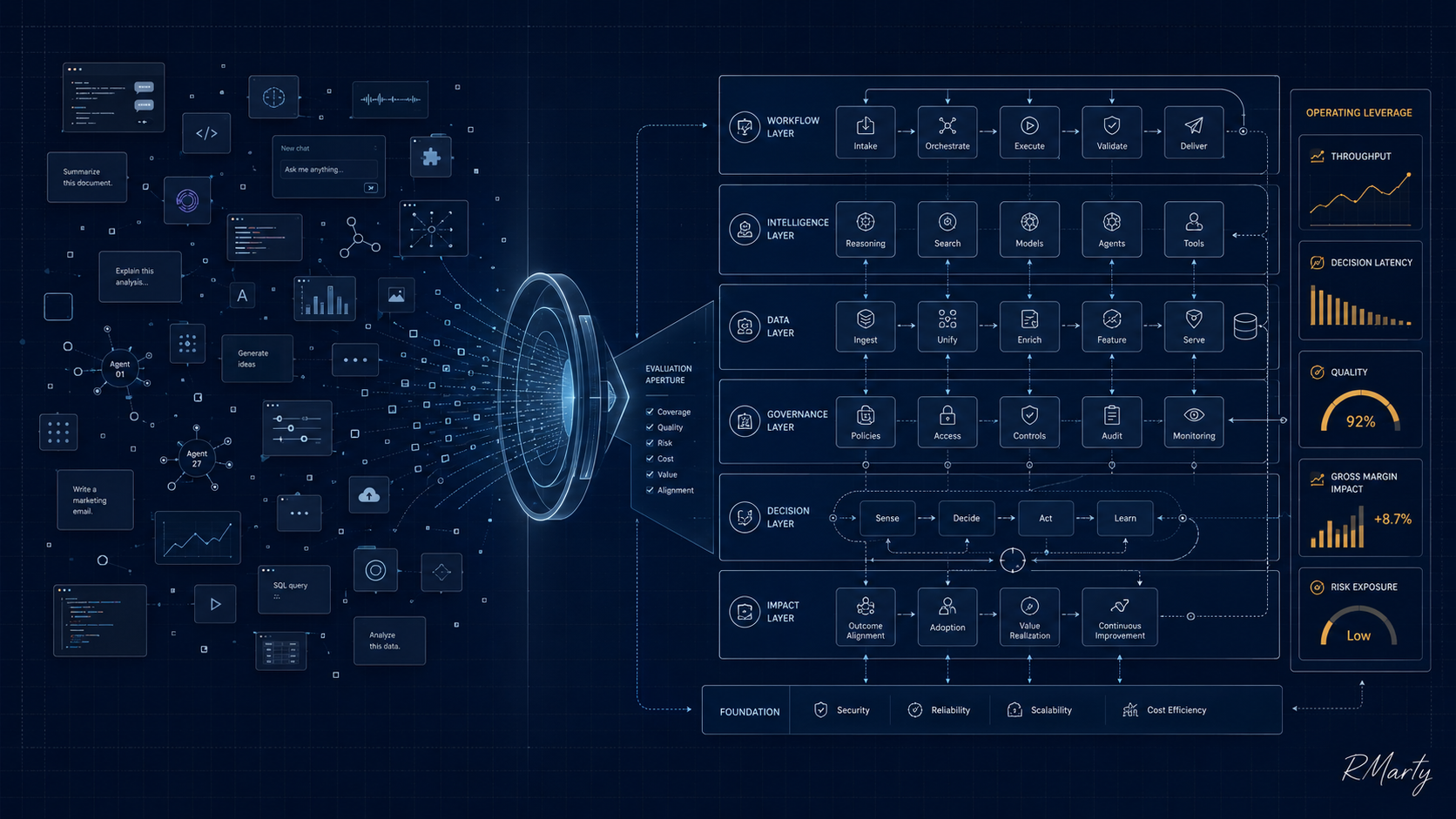
That leads to the next question: if AI is becoming a company operating system layer, what actually belongs inside that layer? The answer is not “a chatbot for every department.” It is a set of shared capabilities that help the company use context, signals, decisions, workflows, and governance more effectively.
The context layer
Every company has operating context, but most of it lives in places AI cannot reliably use: board decks, strategy documents, Slack threads, CRM notes, offsite summaries, and executive memory.
That context matters because it tells the company what good looks like. AI systems need to understand the company’s ICP, strategic priorities, product direction, pricing logic, market narrative, board-level constraints, and risk appetite. Without that, agents can still generate output, but they are not operating from the company’s actual logic.
This is where many AI efforts stay shallow. They automate tasks without encoding the context that should guide those tasks.
The signal layer
A company AI OS also needs signal. That signal comes from the systems where reality shows up:
- Sales calls and win/loss data
- CRM fields and pipeline movement
- Product usage and telemetry
- Support tickets and implementation friction
- Customer success notes and renewal risk
- Roadmap tradeoffs and engineering throughput
- Financial data, margin structure, and cost trends
- Market signals, competitor movement, and regulatory change
The point is not to dump all of this into a model. The point is to make the right signals available, governed, and useful. A company that cannot connect its customer conversations, product reality, and financial outcomes will struggle to make AI operationally meaningful.
The decision layer
The next layer is decision support. This is where AI should help the company reason across functions instead of just accelerating isolated tasks.
For example, sales may hear that a feature is winning deals, support may see that the same feature is causing implementation pain, product may be planning adjacent roadmap work, and finance may care about the gross margin impact. In many companies, those signals never meet in time to shape a better decision.
A useful AI operating layer should help surface those tensions earlier. It should not replace executive judgment, but it should improve the quality and speed of the inputs that judgment depends on.
The execution layer
Once context, signal, and decision support exist, AI can start to push work forward. This is where agents, workflows, and automations become useful.
The execution layer might help:
- Draft follow-ups from customer calls
- Turn product feedback into structured roadmap input
- Identify sales patterns across calls and accounts
- Prepare weekly operating reviews
- Monitor project slippage
- Summarize customer risk
- Suggest next actions for account teams
- Generate board-ready updates from operating data
This is where AI starts to feel less like a productivity tool and more like part of the company’s operating rhythm. But it only works if the earlier layers are in place. Otherwise, execution becomes more automation noise.
The governance layer
The governance layer is often treated as a blocker, but it should be part of the operating system itself. Companies need to define which models are approved, which data sources can be used, what retention rules apply, where human approval is required, and how agent behavior is monitored. The old version of this is a policy page that few people read. The better version is policy that agents can actually access and follow.
That does not remove the need for human governance. It makes governance executable.
The real test
A company AI OS is not a single platform. It is the connective tissue between company context, business signal, decisions, workflows, and governance.
The test is not whether the company has deployed AI tools. The test is whether AI helps the company operate with better speed, clarity, consistency, and control.
If AI only generates more content, it is still a feature layer. If it helps the company sense, decide, execute, and learn, it is becoming an operating layer.
Strong framing, especially the governance layer. Most companies treat it as a gate at the end instead of a property of the system, which is exactly why the execution layer turns into automation noise. The part I’d underline is your point that the OS is connective tissue, not a platform purchase. Anurag Gurtu made a similar argument in a recent interview: governance cannot be bolted on after deployment, it has to be part of the architecture, and the enterprises that win will be the ones with the best operational architecture rather than the best model. Worth a read alongside this: https://ittech-pulse.com/text-interviews/ittech-pulse-exclusive-interview-with-anurag-gurtu-co-founder-and-ceo-of-airrived/
Comment by Tony Zirnoon — August 26, 2026 @ 12:01 pm