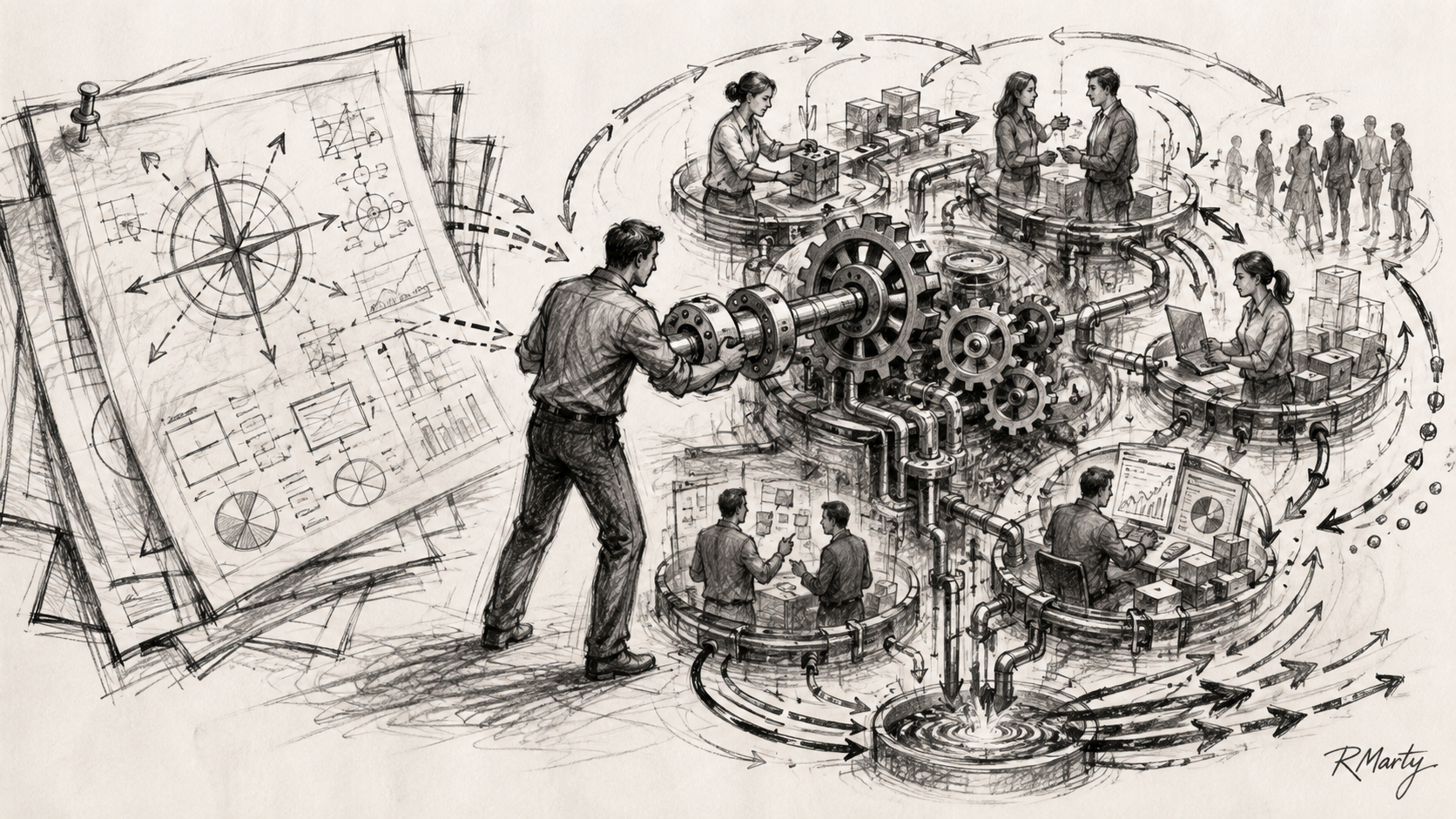
A company strategy deck is not a value-creation plan.
Over the past year, I have worked with private equity firms, boards, MSSPs, MDR providers, and cybersecurity vendors on corporate strategy, product direction, packaging, go-to-market, AI, and operating models. The situations have varied, but the underlying problem is often the same:
Most companies do not lack ideas. They lack the operating system required to turn those ideas into results.
They may have a board strategy, product roadmap, sales plan, AI initiative, and financial target. But these often exist as separate artifacts. Product is not aligned with go-to-market. Packaging does not reflect delivery economics. Sales targets assume demand that has not been validated. The board tracks outcomes without understanding their causes.
In a private equity-backed company, the value-creation plan should be the management system that connects the investment thesis to strategic choices, operating initiatives, accountable owners, leading indicators, and financial outcomes. It is not another presentation. It is how the company runs.
TL;DR
Most strategy problems become operating problems.
Product, packaging, sales, and delivery have to reinforce one another.
Growth problems require diagnosis before more investment.
AI matters when it changes customer outcomes or company economics.
The CEO owns enterprise priorities, cross-functional trade-offs, and resource allocation; the board tests assumptions and improves the quality and speed of consequential decisions.
Packaging Exposes the Operating Model
I recently looked at a cybersecurity services portfolio that had grown organically over many years. The company had strong capabilities, valuable customer relationships, and deep domain expertise. It also had a large menu of services that could be combined in many different ways.
The initial question was how to improve the packaging. The deeper issue was the operating model.
Salespeople had too many options. Customers struggled to understand what they should buy. Delivery teams supported exceptions, custom combinations, and unclear boundaries between recurring services, add-ons, and projects. We worked backward from the customer: What problem caused the customer to buy? Which outcomes mattered? What should be included by default? What belonged in a fully managed service, a co-managed model, an add-on, or a paid project?
That led to a simpler product architecture with clearer entry points, packages, ownership boundaries, and upgrade paths. But this was not merely a marketing exercise. Packaging determines what sales sells, what customers understand, what delivery has to support, and where exceptions enter the system. It reveals whether product strategy and delivery economics are actually aligned.
A complicated catalog is often presented as customer choice. In reality, it can be evidence that the company has avoided making strategic decisions.
Diagnose Growth Before Funding It
In another situation, a company wanted to accelerate growth across several market segments. Two segments were underperforming, but for very different reasons.
In the first, the company was generating interest but failing to convert enough opportunities. The market recognized the problem, but the offer, proof, packaging, or sales process was not strong enough. In the second, too few qualified opportunities were entering the funnel. The company occasionally won business, but the market was not consistently responding to the message.
One was primarily a conversion problem. The other pointed toward ICP, positioning, channel, or market attractiveness. They required different responses. More marketing will not fix a broken buying process. More sales capacity will not fix a weak market position. Better enablement will not create urgency where customers do not feel it.
Yet companies often respond to a missed target by demanding more pipeline, hiring more salespeople, changing compensation, or launching another campaign. Sometimes that works. Sometimes it simply adds cost to a weak market thesis.
Before allocating more capital, management and the board have to establish what is actually true.
Operating Leverage Is the Real Test
For MSSPs, MDR providers, and other technology-enabled services businesses, productization is not defined by having a portal, integrations, proprietary technology, automation, or an AI story. The question is whether the delivery model becomes more scalable as the company grows.
The clearest test is what the next customer requires. If each new customer brings more tuning, analyst work, custom reporting, manual integration, and delivery exceptions, growth remains labor-dependent. If that customer can be served through reusable detections, workflows, automation, and product improvements, operating experience begins to compound.
I have seen enormous expertise trapped inside analysts, tickets, scripts, spreadsheets, and customer-specific processes. Productization means turning that knowledge into standard workflows, captured context, response policies, and automation so experts handle the exceptions rather than repeatable work. Done well, customer outcomes, consistency, and margins improve together.
AI should be judged by the same standard. It matters when it removes an economic or customer constraint: less repetitive work, faster product development or implementation, lower service-delivery costs, better sales productivity, or a meaningfully better customer outcome. If none of the underlying numbers move, the company may have an AI initiative. It does not yet have an AI operating model
The Board Needs Causality. The CEO Must Integrate.
I have seen board reporting with dozens of accurate metrics but limited operational clarity. The board can see that growth, gross margin, or retention is below plan, but not why. If gross margin is deteriorating, is it pricing, vendor cost, implementation effort, support burden, utilization, or delivery exceptions? If bookings are weak, is the problem pipeline, conversion, sales capacity, positioning, product competitiveness, or retention? And if churn is creeping into the customer base, why are we losing these customers? Probably one of the harder questions to answer, but just saying that they went with another competitor is not going to help build a sustainable business.
A useful value-creation plan makes those relationships visible. It connects the investment thesis, strategic priorities, accountable executives, leading indicators, financial outcomes, and decisions required.
The board should not run the company. It should help management confront the right facts and make consequential decisions quickly. Strong board members do more than review dashboards. They improve the quality, speed, and accountability of decisions.
The CEO’s role is different. Functional leaders optimize their areas. The CEO has to optimize the whole company. A custom feature may help close a deal but increase delivery cost. A broad portfolio may expand theoretical market size but weaken sales effectiveness. Cost reductions may improve short-term EBITDA while damaging product relevance. More services may increase revenue but make the company less scalable. The CEO’s unique responsibility is to connect market reality, strategic choices, product, go-to-market, organizational capability, operating cadence, and capital allocation. This is true in a high-growth company, a private equity portfolio company, a founder transition, or a turnaround. The urgency differs, but the work is remarkably similar: establish what is true, decide what matters, stop what does not, align the organization, and turn the strategy into measurable value.
These are the situations I find most interesting: a strong company entering its next phase, a cybersecurity business that has outgrown its original operating model, or an organization where product potential and market opportunity have not yet translated into consistent execution.
If you are a private equity sponsor, board member, or cybersecurity CEO working through one of these transitions—or looking for an operator to lead the next phase—I would welcome the conversation.
Strategy sets the direction. The operating system creates the value.
In the last post, I argued that AI maturity is not about tool count. The real question is whether AI is changing how the company works.
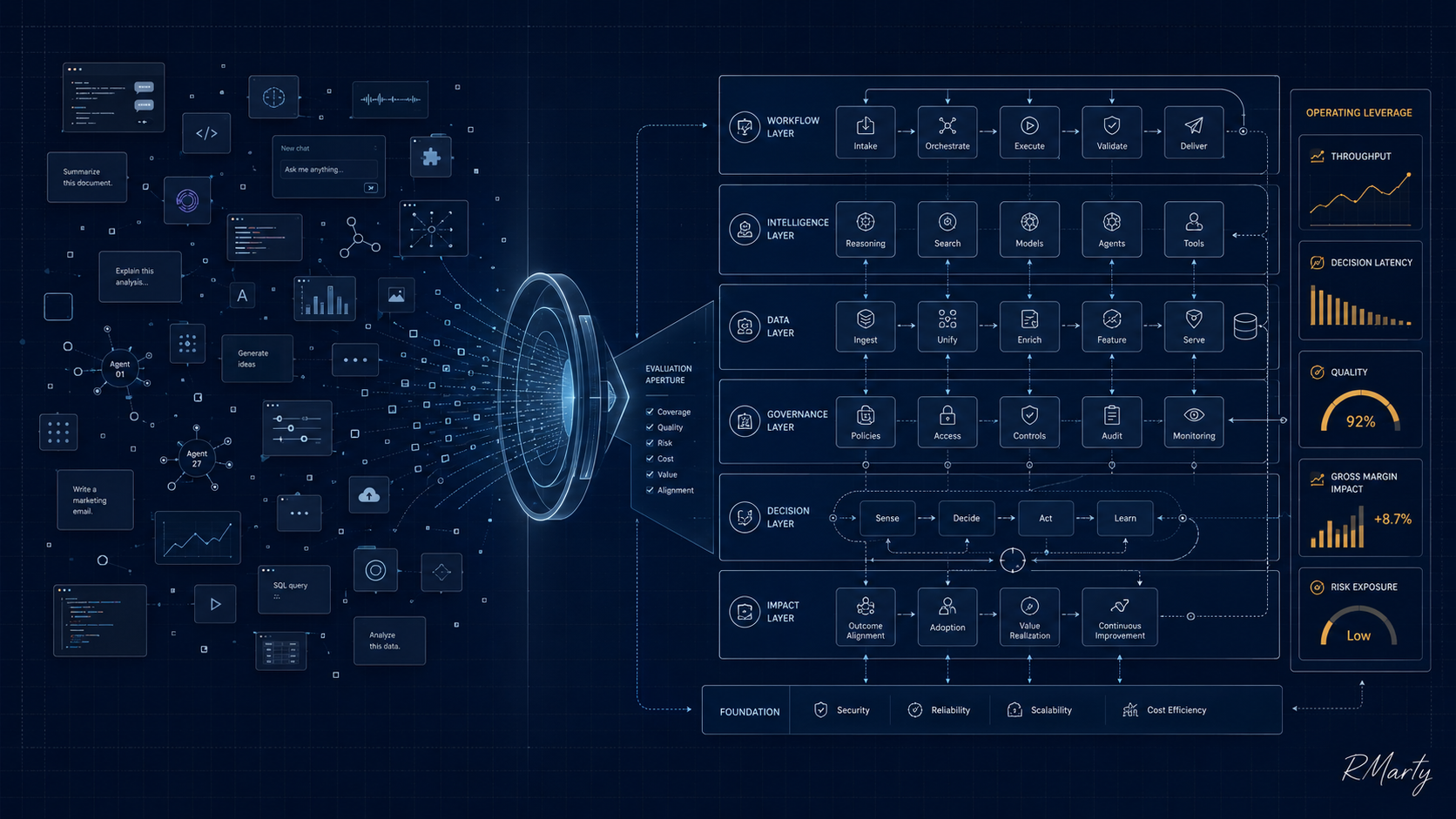
That leads to the next question: if AI is becoming a company operating system layer, what actually belongs inside that layer? The answer is not “a chatbot for every department.” It is a set of shared capabilities that help the company use context, signals, decisions, workflows, and governance more effectively.
The context layer
Every company has operating context, but most of it lives in places AI cannot reliably use: board decks, strategy documents, Slack threads, CRM notes, offsite summaries, and executive memory.
That context matters because it tells the company what good looks like. AI systems need to understand the company’s ICP, strategic priorities, product direction, pricing logic, market narrative, board-level constraints, and risk appetite. Without that, agents can still generate output, but they are not operating from the company’s actual logic.
This is where many AI efforts stay shallow. They automate tasks without encoding the context that should guide those tasks.
The signal layer
A company AI OS also needs signal. That signal comes from the systems where reality shows up:
Sales calls and win/loss data
CRM fields and pipeline movement
Product usage and telemetry
Support tickets and implementation friction
Customer success notes and renewal risk
Roadmap tradeoffs and engineering throughput
Financial data, margin structure, and cost trends
Market signals, competitor movement, and regulatory change
The point is not to dump all of this into a model. The point is to make the right signals available, governed, and useful. A company that cannot connect its customer conversations, product reality, and financial outcomes will struggle to make AI operationally meaningful.
The decision layer
The next layer is decision support. This is where AI should help the company reason across functions instead of just accelerating isolated tasks.
For example, sales may hear that a feature is winning deals, support may see that the same feature is causing implementation pain, product may be planning adjacent roadmap work, and finance may care about the gross margin impact. In many companies, those signals never meet in time to shape a better decision.
A useful AI operating layer should help surface those tensions earlier. It should not replace executive judgment, but it should improve the quality and speed of the inputs that judgment depends on.
The execution layer
Once context, signal, and decision support exist, AI can start to push work forward. This is where agents, workflows, and automations become useful.
The execution layer might help:
Draft follow-ups from customer calls
Turn product feedback into structured roadmap input
Identify sales patterns across calls and accounts
Prepare weekly operating reviews
Monitor project slippage
Summarize customer risk
Suggest next actions for account teams
Generate board-ready updates from operating data
This is where AI starts to feel less like a productivity tool and more like part of the company’s operating rhythm. But it only works if the earlier layers are in place. Otherwise, execution becomes more automation noise.
The governance layer
The governance layer is often treated as a blocker, but it should be part of the operating system itself. Companies need to define which models are approved, which data sources can be used, what retention rules apply, where human approval is required, and how agent behavior is monitored. The old version of this is a policy page that few people read. The better version is policy that agents can actually access and follow.
That does not remove the need for human governance. It makes governance executable.
The real test
A company AI OS is not a single platform. It is the connective tissue between company context, business signal, decisions, workflows, and governance.
The test is not whether the company has deployed AI tools. The test is whether AI helps the company operate with better speed, clarity, consistency, and control.
If AI only generates more content, it is still a feature layer. If it helps the company sense, decide, execute, and learn, it is becoming an operating layer.
In a previous post, I argued that AI is becoming a company operating system layer. The natural next question is how to tell whether that is actually happening inside a company.
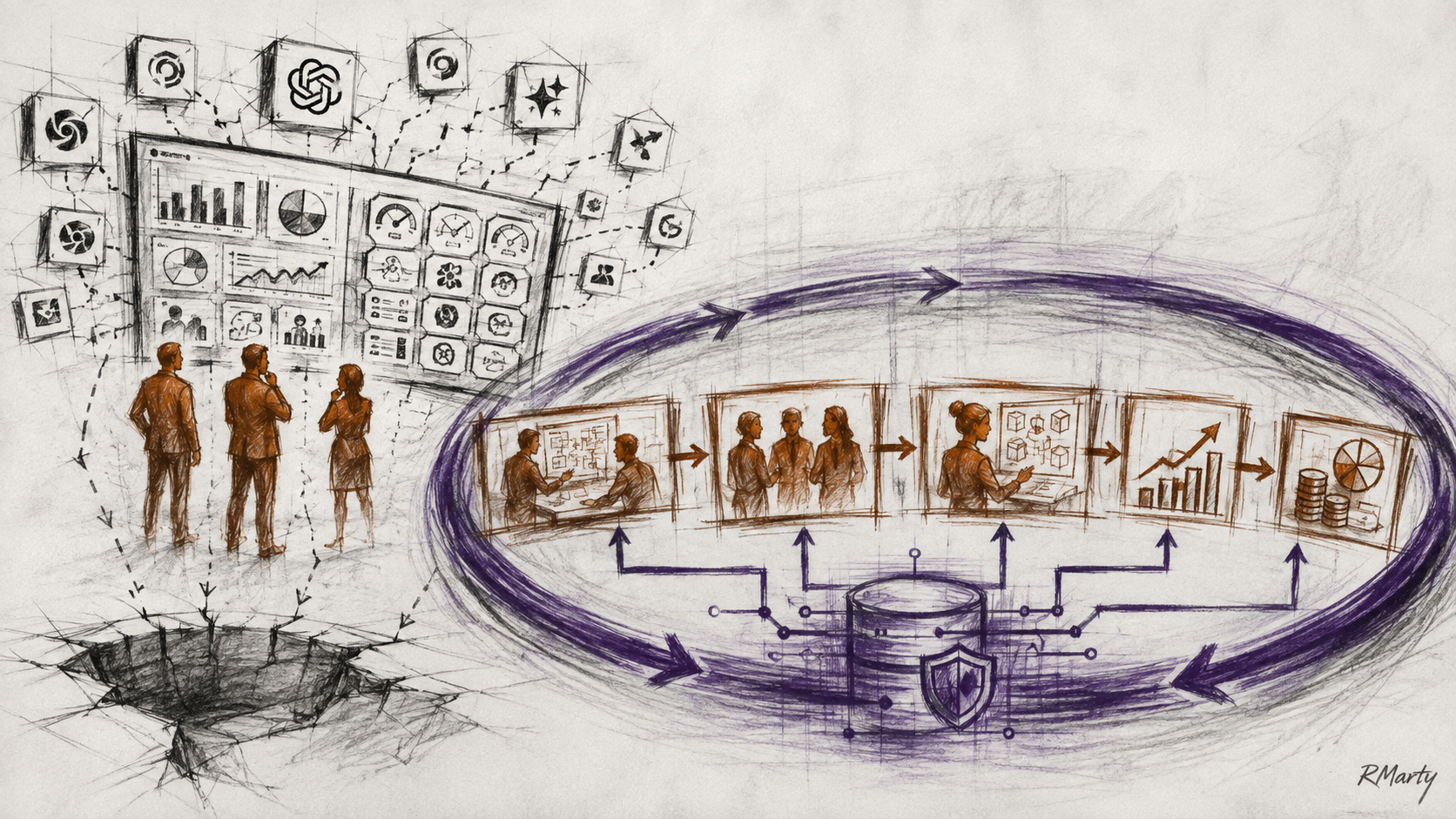
The answer is not how many copilots are deployed, how many employees have access to ChatGPT, Claude, Cursor, or Codex, or how many AI experiments appear on an executive dashboard. Those are adoption signals. They are not operating model signals.
The better question is whether AI is changing how the company actually works.
Start with the workflow, not the tool
One mistake I see in AI maturity conversations is that they start with the wrong question: “How are you using AI?” It sounds reasonable, but it often produces a shallow answer. People list tools. Teams describe experiments. Executives get a dashboard. Everyone feels like something is happening.
A better diagnostic starts earlier. Before asking about AI, you have to understand how the company operates today:
How does engineering ship?
How does product decide what to build?
How does sales learn why it wins or loses?
How does customer success detect risk?
How does finance understand cost and margin impact?
How does governance decide which data AI systems can access?
If those workflows are unclear, inconsistent, or poorly instrumented, AI will not magically fix them. It will usually amplify the fragmentation.
AI activity is not AI operating leverage
Most companies already have plenty of AI activity. Engineers are using coding agents. Marketing teams are generating copy. Sales teams are summarizing calls. Product teams are drafting requirements. Support teams are experimenting with automation.
The problem is that much of this is happening independently. Different teams use different tools. Different people create different prompts. Different functions maintain different versions of the truth. Governance is often a policy page somewhere, not something agents can actually read and enforce. Management may see usage, but not impact.
That is not an AI operating model. It is distributed experimentation. A company can have high AI usage and still have low AI maturity.
What a real diagnostic should look for
A useful AI maturity assessment should not just ask who has licenses. It should look at whether AI is improving the operating system of the company.
That means asking:
Are existing workflows documented well enough for AI to assist them?
Are teams using shared patterns, or is every function inventing its own?
Are the right data sources available, clean, and governed?
Can the company measure whether AI improves speed, quality, cost, or predictability?
Do agents know what data they are allowed to use, or are rules trapped in static documents?
Is AI helping the company learn from customer calls, support tickets, product usage, roadmap decisions, and financial outcomes?
The point is not to create a more elaborate AI dashboard. The point is to understand whether AI is becoming part of how the company senses, decides, executes, and learns.
The board-level question
For CEOs, boards, and investors, the question should not be: “Do we have an AI strategy?” It should be whether AI is creating operating leverage.
A board should be asking:
Is AI reducing decision latency?
Is it improving engineering throughput?
Is it helping sales understand why deals are won or lost?
Is it improving retention signal?
Is it exposing risk earlier?
Is it changing the margin structure of the business?
If the answer is no, the company may still be in the experimentation phase, even if AI usage looks high.
That is why AI maturity is not about tool count. It is an operating model assessment. The companies that get this right will not be the ones with the longest list of AI tools. They will be the ones that turn AI into a repeatable way to improve workflows, decisions, governance, and execution. And last but not least, companies with clean workflows that are ideally already documented, will win in adopting AI quickly.
I had a few conversations over the past days that all pointed to the same conclusion: many technology companies are still being built like old SaaS companies. That is a mistake. If you are building a technology product now, the priority is not a polished frontend. It is the backend: the data layer, the ontology, the APIs, the analytics layer, the authentication model, and the infrastructure that makes AI agents fast, reliable, and cheap to run on top of the data backend. The frontend still matters, but it should not be the center of gravity anymore.
TL;DR
Start with the backend and data model, not the dashboard.
Build for token efficiency as a product requirement, not just an infrastructure metric.
Expose core capabilities through APIs and agent-friendly interfaces first.
Keep the UI light, flexible, and increasingly self-serve.
If every deployment needs heavy forward deployed engineering, the product is not ready yet.
The Moat Is Moving Down the Stack
In the old SaaS model, a lot of value sat in the application layer. You built workflows, dashboards, role-based views, and configuration screens. In AI-native software, that is no longer enough. The durable part of the company is increasingly lower in the stack: the system that structures data correctly, retrieves the right context quickly, exposes useful actions cleanly, and does all of that in a reliable and token-efficient way.
If that layer is weak, the rest of the product becomes slow, expensive, brittle, and hard to customize. If that layer is strong, you can build a surprising amount on top of it very quickly.
The UI Should Get Thinner
A lot of teams still think about product development as: first build the dashboard, then add AI to it. I think it is increasingly the opposite. First build the backend that can answer questions, retrieve context, execute actions, and expose capabilities cleanly. Then add lightweight interfaces on top.
Initially, those interfaces may be very thin. In some cases they may barely be a product UI at all. A technical user might interact through Claude, another agent interface, or an internal tool layer. Over time, you can add more purpose-built interfaces and dashboards, but those should sit on top of a backend that already works well in a headless way.
Token Efficiency Is a Product Decision
One of the bigger mistakes right now is treating token usage as a backend optimization problem. It is not. It is a product design problem. If your system cannot give agents the right context in the right shape, the product becomes costly to operate and difficult to scale. That affects margins, response times, user experience, and the kinds of workflows that are even viable.
This is why the backend matters so much. You need data structures, query systems, and analytics layers that are built for AI interaction, not just for human dashboards. A beautiful interface on top of an inefficient backend is not an AI product. It is a demo with a future cost problem.
The Goal Is Self-Serve Customization
A lot of tech companies are also running into the same trap: they need too much forward deployed engineering to make each customer successful. That is understandable for now, but it is not where you want to stay. The goal should be to make the platform configurable enough that a solutions engineer, a sales engineer, or eventually even the customer can shape the experience without constantly pulling in core backend engineers.
That only works if the system is designed the right way. If the logic, data model, and capabilities are modular and exposed well, you can let people create their own views, workflows, and operating layers on top. If not, every customer request turns into a product detour.
Build the engine first. Build the data layer properly. Make it fast, cheap, reliable, and cleanly exposed. Then let the frontend become lighter, more dynamic, and more self-serve over time. That is increasingly the difference between an AI first company and a SaaS company with an AI feature.