



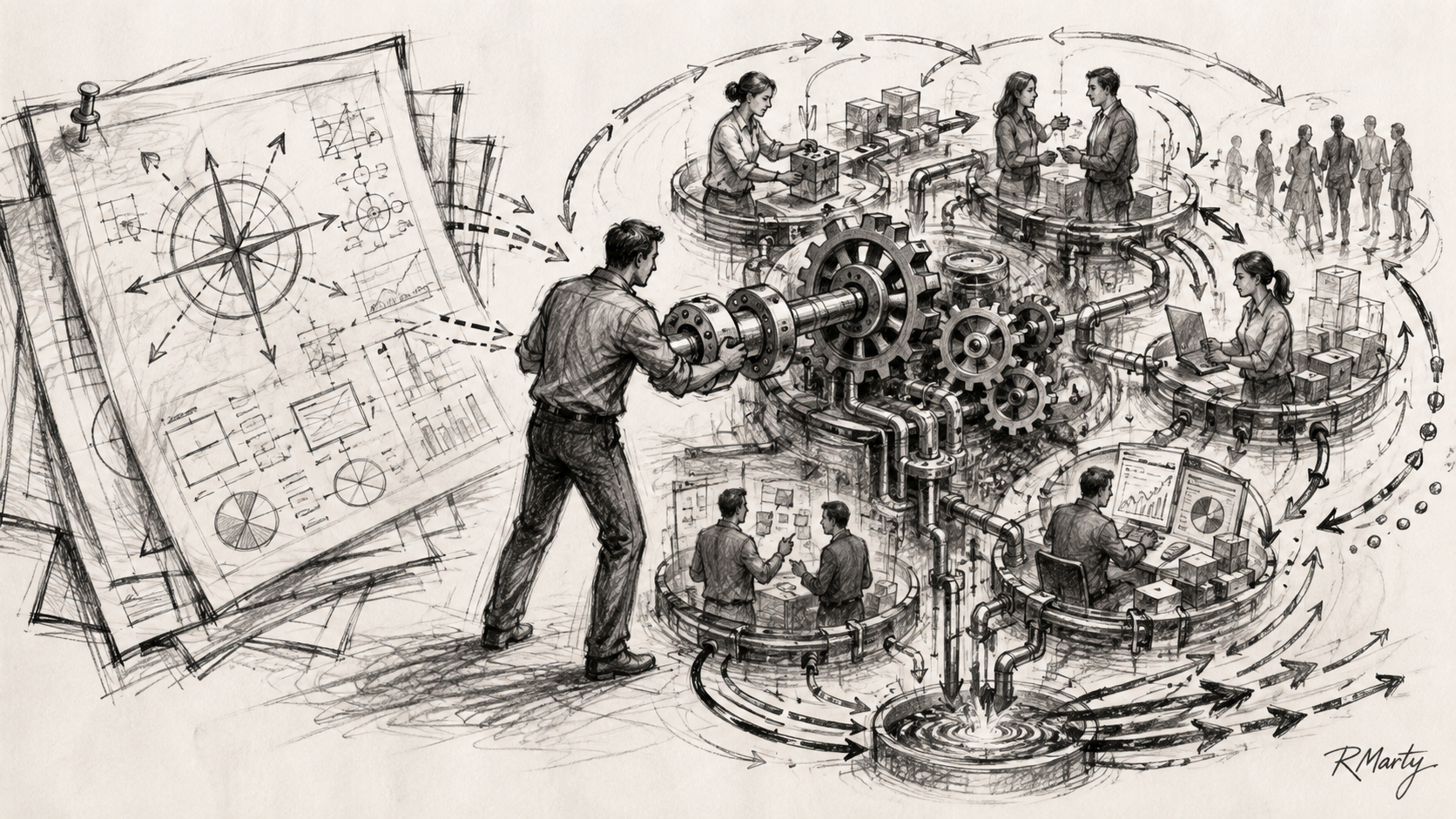
A company strategy deck is not a value-creation plan.
Over the past year, I have worked with private equity firms, boards, MSSPs, MDR providers, and cybersecurity vendors on corporate strategy, product direction, packaging, go-to-market, AI, and operating models. The situations have varied, but the underlying problem is often the same:
Most companies do not lack ideas. They lack the operating system required to turn those ideas into results.
They may have a board strategy, product roadmap, sales plan, AI initiative, and financial target. But these often exist as separate artifacts. Product is not aligned with go-to-market. Packaging does not reflect delivery economics. Sales targets assume demand that has not been validated. The board tracks outcomes without understanding their causes.
In a private equity-backed company, the value-creation plan should be the management system that connects the investment thesis to strategic choices, operating initiatives, accountable owners, leading indicators, and financial outcomes. It is not another presentation. It is how the company runs.
TL;DR
- Most strategy problems become operating problems.
- Product, packaging, sales, and delivery have to reinforce one another.
- Growth problems require diagnosis before more investment.
- AI matters when it changes customer outcomes or company economics.
- The CEO owns enterprise priorities, cross-functional trade-offs, and resource allocation; the board tests assumptions and improves the quality and speed of consequential decisions.
Packaging Exposes the Operating Model
I recently looked at a cybersecurity services portfolio that had grown organically over many years. The company had strong capabilities, valuable customer relationships, and deep domain expertise. It also had a large menu of services that could be combined in many different ways.
The initial question was how to improve the packaging. The deeper issue was the operating model.
Salespeople had too many options. Customers struggled to understand what they should buy. Delivery teams supported exceptions, custom combinations, and unclear boundaries between recurring services, add-ons, and projects. We worked backward from the customer: What problem caused the customer to buy? Which outcomes mattered? What should be included by default? What belonged in a fully managed service, a co-managed model, an add-on, or a paid project?
That led to a simpler product architecture with clearer entry points, packages, ownership boundaries, and upgrade paths. But this was not merely a marketing exercise. Packaging determines what sales sells, what customers understand, what delivery has to support, and where exceptions enter the system. It reveals whether product strategy and delivery economics are actually aligned.
A complicated catalog is often presented as customer choice. In reality, it can be evidence that the company has avoided making strategic decisions.
Diagnose Growth Before Funding It
In another situation, a company wanted to accelerate growth across several market segments. Two segments were underperforming, but for very different reasons.
In the first, the company was generating interest but failing to convert enough opportunities. The market recognized the problem, but the offer, proof, packaging, or sales process was not strong enough. In the second, too few qualified opportunities were entering the funnel. The company occasionally won business, but the market was not consistently responding to the message.
One was primarily a conversion problem. The other pointed toward ICP, positioning, channel, or market attractiveness. They required different responses. More marketing will not fix a broken buying process. More sales capacity will not fix a weak market position. Better enablement will not create urgency where customers do not feel it.
Yet companies often respond to a missed target by demanding more pipeline, hiring more salespeople, changing compensation, or launching another campaign. Sometimes that works. Sometimes it simply adds cost to a weak market thesis.
Before allocating more capital, management and the board have to establish what is actually true.
Operating Leverage Is the Real Test
For MSSPs, MDR providers, and other technology-enabled services businesses, productization is not defined by having a portal, integrations, proprietary technology, automation, or an AI story. The question is whether the delivery model becomes more scalable as the company grows.
The clearest test is what the next customer requires. If each new customer brings more tuning, analyst work, custom reporting, manual integration, and delivery exceptions, growth remains labor-dependent. If that customer can be served through reusable detections, workflows, automation, and product improvements, operating experience begins to compound.
I have seen enormous expertise trapped inside analysts, tickets, scripts, spreadsheets, and customer-specific processes. Productization means turning that knowledge into standard workflows, captured context, response policies, and automation so experts handle the exceptions rather than repeatable work. Done well, customer outcomes, consistency, and margins improve together.
AI should be judged by the same standard. It matters when it removes an economic or customer constraint: less repetitive work, faster product development or implementation, lower service-delivery costs, better sales productivity, or a meaningfully better customer outcome. If none of the underlying numbers move, the company may have an AI initiative. It does not yet have an AI operating model
The Board Needs Causality. The CEO Must Integrate.
I have seen board reporting with dozens of accurate metrics but limited operational clarity. The board can see that growth, gross margin, or retention is below plan, but not why. If gross margin is deteriorating, is it pricing, vendor cost, implementation effort, support burden, utilization, or delivery exceptions? If bookings are weak, is the problem pipeline, conversion, sales capacity, positioning, product competitiveness, or retention? And if churn is creeping into the customer base, why are we losing these customers? Probably one of the harder questions to answer, but just saying that they went with another competitor is not going to help build a sustainable business.
A useful value-creation plan makes those relationships visible. It connects the investment thesis, strategic priorities, accountable executives, leading indicators, financial outcomes, and decisions required.
The board should not run the company. It should help management confront the right facts and make consequential decisions quickly. Strong board members do more than review dashboards. They improve the quality, speed, and accountability of decisions.
The CEO’s role is different. Functional leaders optimize their areas. The CEO has to optimize the whole company. A custom feature may help close a deal but increase delivery cost. A broad portfolio may expand theoretical market size but weaken sales effectiveness. Cost reductions may improve short-term EBITDA while damaging product relevance. More services may increase revenue but make the company less scalable. The CEO’s unique responsibility is to connect market reality, strategic choices, product, go-to-market, organizational capability, operating cadence, and capital allocation. This is true in a high-growth company, a private equity portfolio company, a founder transition, or a turnaround. The urgency differs, but the work is remarkably similar: establish what is true, decide what matters, stop what does not, align the organization, and turn the strategy into measurable value.
These are the situations I find most interesting: a strong company entering its next phase, a cybersecurity business that has outgrown its original operating model, or an organization where product potential and market opportunity have not yet translated into consistent execution.
If you are a private equity sponsor, board member, or cybersecurity CEO working through one of these transitions—or looking for an operator to lead the next phase—I would welcome the conversation.
Strategy sets the direction. The operating system creates the value.