October 29, 2008
 VizSec is a fairly academic conference that brings together the fields of security and visualization. The conference had an interesting mix of attendees: 50% came from industry, 30% from academia, and 20% from government. I had the pleasure of being invited to give a talk about DAVIX and also participate on a panel about the state of security visualization in the market place.
The highlight of the conference was definitely Ben Shneiderman’s keynote. I was very pleased with some of the comments that Ben made about the visualization community. First he criticized the same thing that I call the “industry – academia dichotomy”. In his words:
“[There is a] lack of applicability of research.”
I completely agree and if you have seen me talk about the dichotomy, I outline a number of examples where this becomes very obvious.
The second quote from Ben that I would like to capture is the following:
“The purpose of viz is insight, not pictures”
Visualization is about how to present data. I am not always sure that people understand that.
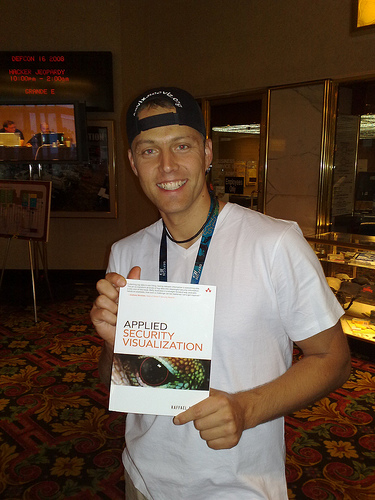
Unfortunately, I wasn’t prepared to capture what Ben said about my book (Applied Security Visualization.) He brought his copy that I had sent him. He talked about the book for quite a bit and specifically mentioned all the treemaps that I have used to visualize a number of use cases. I felt very honored that Ben actually looked at the book and had such great things to say about it. The following lunch with Ben was a great pleasure as well, filled with some really interesting visualization discussions.
September 6, 2008
 A little bit more than two years ago, I approached Jessica Goldstein from Addison Wesley to write a book about security visualization. We sat down during BlackHat 2006 and discussed my idea. It didn’t take much to convince her that they should get me on board. I went home after the conference and started putting together a table of contents. Here is the very first TOC that I submitted:
- Introduction
- Data Sources
- Visualization
- From Data To Visuals
- Visual Security Analysis
- Situational Awareness
- Perimeter Threat
- Compliance
- Insider Threat
- Data Visualization Tools
If you read the book, you will notice that this is pretty much what I ended up with. More or less. An interesting fact is that at the time of submitting the TOC, I had no idea what to exactly write about in the compliance and insider threat chapters. The even more interesting fact is that a lot of people told me that their favorite chapter is the insider threat chapter.
 After submitting the TOC to Jessica, she had me fill out some more marketing questions about the book. Things like target audience, competitive books, etc. After handing that in, it went silent for a bit. Jessica was selling the book internally. And then things started to look not so good. Jessica went on maternity leave. Kristin took over and got the proposal review process lined up. I asked some people in the industry to have a look over my proposal and provide feedback to the publisher. Questions like: “Why is Raffy the right person to write this book?” “Is there a market for this book?” etc. were being asked. I received the six really great reviews (thanks guys!) mid December 2006. On December 19th, I received an email with the contract to write the book. I sent the contract off to a friend of mine who is a lawyer, just because I was a bit worried about intellectual property rights. After a few emails also with Addison, I felt much better. They are not at all interested in any IP. They just want the copyright, which was totally fine with me. Then, finally, on January 17th, I signed and was under contract to write about 300 pages about security visualization.
After a few days, I received an ISBN number for the book and a ton of material about style guides and how to go about writing the book. All very exciting. I decided to not write my book in TeX, unlike my masters thesis. That was definitely a smart decision. It turned out that using Word wasn’t that bad. The template from Addision made it really easy to format the text correctly. I actually ended up using VI to write the original text without any formatting. Once it was all done, I copied the raw text into Word and started formatting. The reason for doing this is that I am so much quicker in VI than I am in Word. (And hitting the ESC key in Word is not something you want to be doing too much.)
 One of the next steps was to put together a timeline. Well, it was sort of aggressive. The version of the schedule I could find in my archives shows that I was planning on being done mid September 2007. Well, I missed that by only a year 😉 I attribute a lot to the fact that I didn’ really know how to write (seriously) and to the chatpers for which I had to do a lot of research.
I definitely enjoyed the process of writing the book. The folks at Addison Wesley were awesome. They kept motivating me along the way and provided great insights into the writing process. What I am still very impressed with is the PR aspects. Early on, they hooked me up to film a video cast about the book. After publishing the book, I get about an email a week for some press opportunity. Keep them coming 😉
Here is a fun fact: In ~/Data/projects/vis_addision, where I have all the material for the book, I accumulated 1.1GB of data. Pretty crazy.

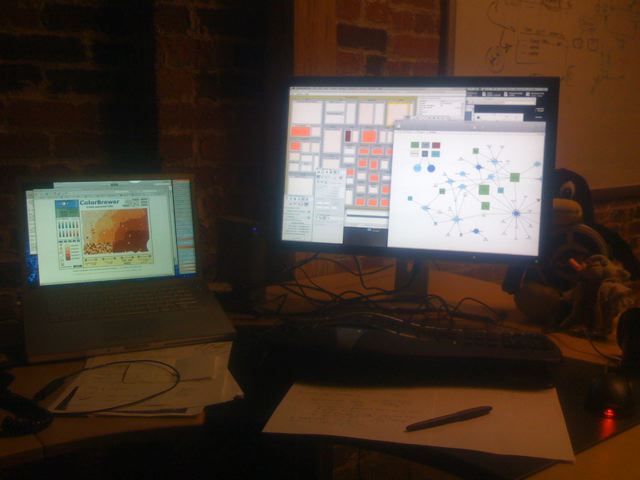
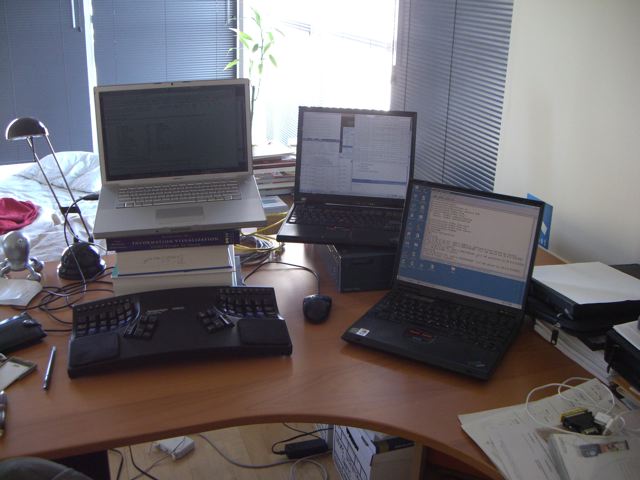
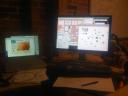
 Are you thinking about writing a book? Do it, but make sure you have time! I spent a LOT of time in the local coffee shop (picture on the left). I always had printouts with me to work on corrections. The picture on the right I took at 6.30am in Taipei. Yes, it’s a full-time job! I learned a lot! I made amazing connections. And I had fun! One piece of advice: make sure you have a good publisher!
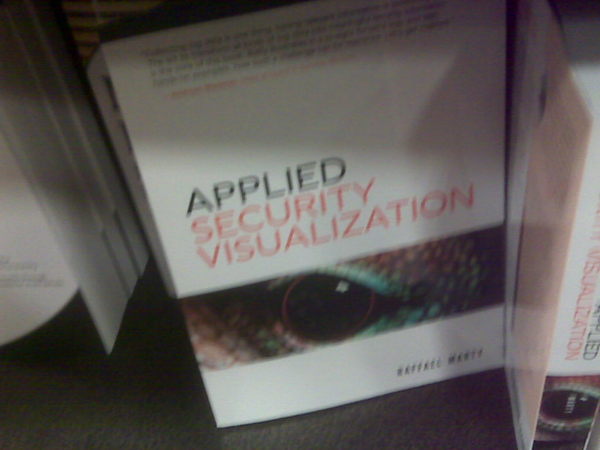
I haven’t seen the book in my local Barnes and Nobles yet. Well, I checked two weeks ago. But a friend (@jjx) sent me this picture. So, apparently some book stores have it in stock:

 Next Tuesday I will be speaking in Graz, Austria at the FIT-IT event. The topic of the event is Trust in IT Systems & Visual Computing. I am giving a keynote in the afternoon about the topic of Security Research 2.0. I will be hitting on one of my favorite topics, the dichotomy between security and visualization. We need to all work hard on combining the worlds of visualization and the security. We have all seen what happens if security people are writing visualization tools. And we have seen what happens when visualization people try to understand networking and security. I can show you some pretty bad papers that get either side completely wrong. Maybe I am just too picky, but if you read some of the papers that I reviewed for RAID and VizSec, you would probably agree with me.
While talking about RAID and VizSec, the conferences are taking place in a week at MIT in Boston. I will be giving a short presentation on DAVIX with Jan Monsch and will also be part of a panel discussion. Looking forward to make my points about visualization there. I am going to stay for RAID and hope to catch up with my former collegues from IBM research. Drop me a note if you are attending as well.
August 20, 2008
 I recorded a couple of podcasts and did some interviews lately about the book. If you are interested in listening in on some of the press coverage:
More information about the Applied Security Visualization book is on the official book page. I am working on figuring out where to put an Errata. There were some minor issues and typos that people reported. If you find anything wrong or you have any generic comments, please let me know!
August 14, 2008
I just saw the first Amazon review for my book. I just don’t understand why the person only gave it four stars, instead of five 😉 Just kidding. Thanks for the review! Keep them coming!
August 13, 2008
 The Applied Security Visualization book is DONE and available in your favorite store!
Last Tuesday when I arrived at BlackHat, I walked straight up to the book store. And there it was! I held it in my hands for the first time. I have to say, it was a really emotional moment. Seeing the product of 1.5 years of work was just amazing. I am really happy with how the book turned out. The color insert in the middle is a real eye-catcher for people flipping through the book and it greatly helps making some of the graphs better interpretable.
 I had a few copies to give away during BlackHat and DefCon. I am glad I was able to give copies to some people that have contributed by inspiring me, challenging me, or even giving me very specific use-cases that I collected in the book. Thanks everyone again! I really appreciate all your help.
People keep asking me what the next project is now that the book is out. Well, I am still busy. secviz.org is one of my projects. I am trying to get more people involved in the discussions and get more people to contribute graphs. Another project I am starting is to build out a training around the book, which I want to teach at security conferences. I have a few leads already for that. Drop me a note if you would be interested in taking such a training. Maybe I will also get some time to work on AfterGlow some more. I have a lot of ideas on that end…
During DefCon, I recorded a PodCast with Martin McKeay where I talk a little bit about the book.
July 9, 2008
I just finished reading the NIST 800-41 draft about “Guidelines on Firewalls and Firewall Policy“. The guideline does a great job of outlining the different types of firewalls that exist and how to correctly setup a firewall architecture.
The topic that falls fairly short is logging:
- Section 5.2.3 (Configuring Logging and Alerts) mentions logging very briefly.
- I am positively surprised that it mentions the logging of rule changes on the firewall, which is inherently hard in, for example, IPTables.
- NIST asks for storing the logs locally on the firewall. I don’t agree with that at all. I don’t care whether the logs are kept locally. What I really care about is that the logs are centrally collected. Or in a very small environment, that there are logs at all.
- I was really hoping that this was finally the document which would outline what to log exactly. What traffic should I be logging on the firewall? All the traffic? Just denied packets? Do you log on the incoming interface? And so on. None of these questions is addressed. Not even whether passed traffic should be logged at all. There should at least be some discussion around that.
- Log analysis is not mentioned either. I was hoping that aside from just logging recommendations, the guideline would quickly mention what to do with the log files. How do you use them? Are they meant mainly for forensic purposes or are they used for proactive analysis? This would help justify the storage cost of the logs and push some implementations to actually implement logging.
I sent this blog post to the authors of the guidelines. Hopefully they are going to address some of this. And again, the general structure and contents of NIST 800-41 are great!
June 17, 2008
 I am presenting at the FIRST 2008 conference in Vancouver next week. I am speaking on my birthday, June 25th, from 9.50 until 12.50. The topic is “Applied Security Visualization” – the same as my book title. I am going through some of the material from the book and show how visualization can be used to analyze log files.
Some of the highlights:
- I am going to show how you can use Splunk to manage not just single-line logs, but also analyze multi-line data, such as data from top, ps, etc.
- I am showing how you can use AfterGlow with Splunk.
- I am probably going to show a sneak peak of DAVIX. The Data Visualization and Analysis Linux (DAVIX) is a live CD that will be released at BlackHat this year.
May 30, 2008
The Applied Security Visualization book is slowly coming together. I finished implementing all the reviews from my reviewers yesterday. This means I am almost done. The only thing left is the introduction.
By the way, my reviewers were absolutely amazing. I couldn’t have wished for a better team. Thanks guys!
The rought-cuts version of “Applied Security Visualization” is now also available. It’s an electronic version of, I think, 4 of the chapters. You can also pre-order the book on Amazon. This is all really exciting. Finally, after 1.5 years, the book is close to be done. Let’s hope for a launch in August, at BlackHat!
May 14, 2008
I just joined the program committee for this year’s WASL conference. I am really curious what papers will be submitted for this. Talking about papers, I have been busy lately reviewing papers for RAID and soon the papers for VizSec are due as well. While I enjoy reading these papers, it’s been too busy lately with finishing my book and looking these papers. But at least the book is getting close!
Here is the description for WASL:
Join us in San Diego, CA, December 7, 2008, for the First USENIX Workshop on the Analysis of System Logs. System logs represent a rich source of information for the analysis and diagnosis of system problems and prediction of future system events. However, their lack of organization and the general lack of semantic consistency among the information from various software and hardware vendors means that most of this information content is wasted. WASL ’08 will focus on novel techniques for extracting more information from existing logs and on methods to improve the information content of future logs.



 VizSec is a fairly academic conference that brings together the fields of security and visualization. The conference had an interesting mix of attendees: 50% came from industry, 30% from academia, and 20% from government. I had the pleasure of being invited to give a talk about DAVIX and also participate on a panel about the state of security visualization in the market place.